

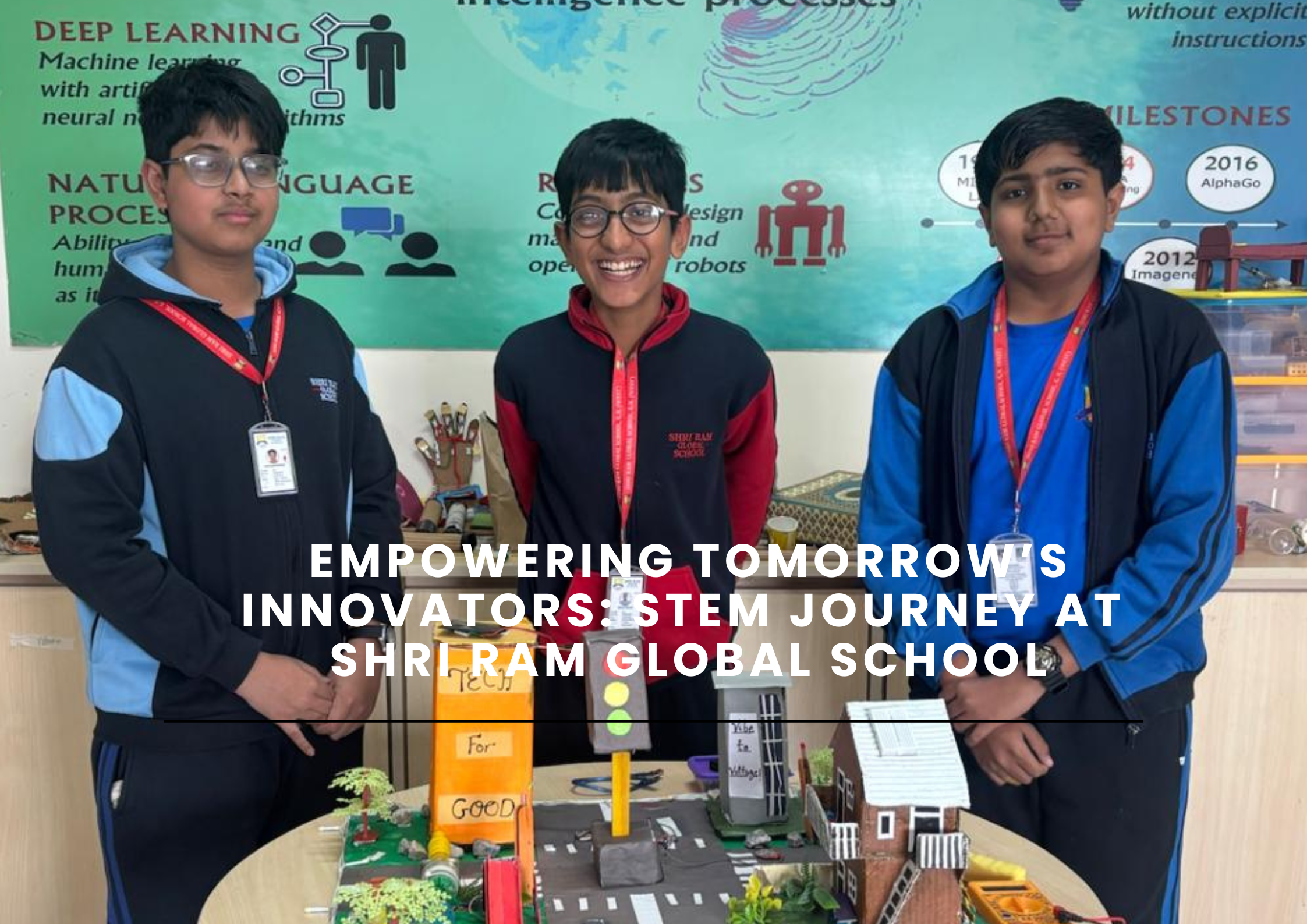
In today’s interconnected world, education must equip students to tackle real
life challenges by integrating knowledge across disciplines. SRGS recognizes that the primary years are the most receptive phase for nurturing innovation and curiosity.
• Problem or Need Addressed: STEM kits are typically expensive, creating a barrier to hands-on learning.
• Target Group and Timeline: Students in Grades 3–5; initiated from April 2023 with ongoing implementation.
Objectives
• Learning Outcomes Targeted: Develop analytical thinking, scientific inquiry, and problem
solving skills.
• STEM Skills or Competencies Focused: Design thinking, observation, experimentation,
modelling, and collaboration.
Description of the Practice
• What Was Done: A grade-wise STEM curriculum was introduced using custom-developed,
low-cost STEM kits.
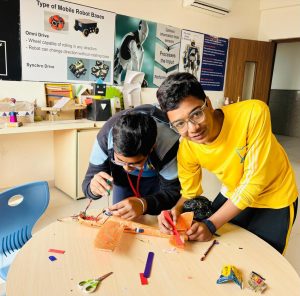
• How Was It Conducted: Integrated into the Book List; students participated in guided
activities throughout the year.
• Materials/Tools Used: Custom STEM kits (₹500–₹900); recyclable materials; basic electronics and mechanics components.
Methodology
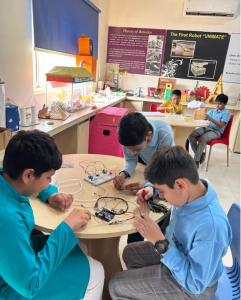
• Pedagogical Approach: Project-based and inquiry-based learning.
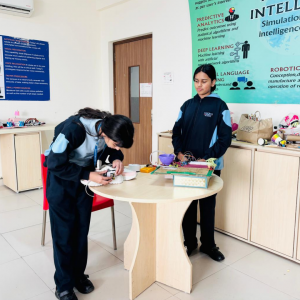
• Role of Students and Teachers: Students lead experiments; teachers facilitate understanding and encourage critical thinking.
• Curriculum Integration: Seamlessly blended with science, math, and art curricula.
Evidence-Based Impact
• Student Learning Outcomes: Completion of 15–18 STEM projects per year.
• Student Products: Models such as harmonicas, balloon rockets, electromagnets, robotic
hands, and solar towers.
• Behavioral Changes: Increased engagement, curiosity, and peer collaboration.
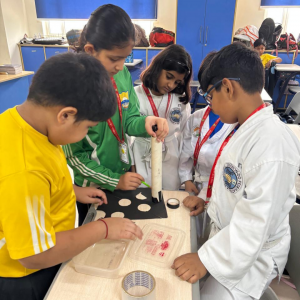
Activities Conducted for Grades 3–5
Grade 3 Activities:
• Harmonica: Students constructed simple harmonicas and learned about sound waves.
• Graphite Circuit: Students created circuits using graphite and explored the basics of
electricity.
• Balloon Rocket: Students experimented with balloon rockets to understand Newton’s Third Law of Motion.
• Breath of Fun: Students engaged in activities that demonstrated principles of air pressure
and Demonstrated Lung Function as well.
• Ball Launcher: Students built ball launchers to study projectile motion.
• Math Bot: Students created robots using various mathematical shapes.
• Marble Maze/Marble Run: Students designed marble runs to explore concepts of gravity
and motion.
• Cup and Ball Launcher: Students constructed cup and ball launchers to learn about force and energy.
• Puzzle (A4 Size Sheet): Students designed puzzles to enhance problem-solving skills.
Grade 4 Activities:
• Anemometer: Students built anemometers to measure wind speed and learned about
meteorology.
• Electromagnet: Students created electromagnets and studied the principles of magnetism and electricity.
• Table Lamp: Students constructed table lamps and learned about electrical circuits.
• Art Bot: Students designed and built robots that could scribble.
• Carnival Ride: Students created models of carnival rides to understand mechanics and
engineering.
• Bernoulli’s Theorem: Students conducted experiments to observe Bernoulli’s principle in
action.
• Spectroscope: Students built spectroscopes to study light and color.
• Robotic Hand: Students designed robotic hands to learn about biomechanics.
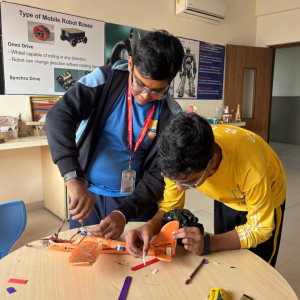
Grade 5 Activities:
• Thermometer: Students constructed thermometers and learned about temperature
measurement.
• Stethoscope: Students built stethoscopes and explored the principles of sound and health
science.
• Pendulum: Students conducted experiments with pendulums to understand motion and
timing.
• Hydraulic Systems: Students created hydraulic systems to study fluid mechanics.
• Cardboard Automata: Students designed automata to learn about mechanics and motion.
• Solar Updraft Tower: Students built solar updraft towers to explore renewable energy.
• Parachute: Students created parachutes to study aerodynamics.
• Compass: Students built compasses to understand magnetism and navigation.
Novelty and Relevance
• Unique Aspects: Use of self-created kits that drastically reduce cost and enhance
accessibility.
• Connection to Real-World Problems: Activities explore sound, electricity, renewable energy, biomechanics, and aerodynamics.
Inclusivity and Equity
• Diverse Participation: Equal participation by boys and girls across all sections.
• Support for Underrepresented Groups: Kits designed to be safe and accessible for students with varied learning needs.
Scalability and Replicability
• Potential to Implement Elsewhere: Easily adaptable with basic resources and teacher
training.
• Necessary Conditions for Replication: Access to low-cost materials, collaborative planning.
• Documentation Available: Curriculum plans, activity guides, photographs,
Sustainability and Cost Effectiveness
• Long-Term Viability: Kits reused annually; design evolves based on feedback.
• Budget and Cost Savings: ₹500–₹900 per kit; uses locally available items.
• Use of Local Materials: Strong emphasis on recyclables and readily available tools.
Learnings and Reflections
• Challenges Faced: Limited resources; initial resistance to DIY kits.
• Solutions: Teacher-led prototype demonstrations and iterative kit designs.
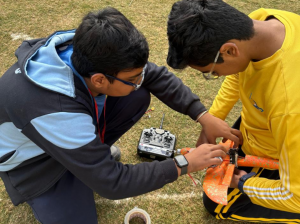
Development of Skills: Each STEM activity helps develop a range of skills, including analytical thinking, scientific inquiry, and technical proficiency. Students gain practical experience and confidence in applying their knowledge to real-world situations. Students are more engaged and motivated when participating in STEM activities. These projects provide a dynamic and interactive learning environment that enhances student understanding and retention of scientific concepts.
The STEM curriculum at our school has proven to be highly beneficial for student development. By providing hands-on learning experiences, fostering critical thinking and problem-solving skills, and encouraging innovation, our STEM program prepares students for future success in scientific and technological fields.
About the author
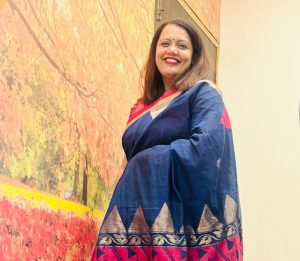 Kabita Mishra holds a B.E. in Computer Engineering from Pokhara University, Nepal. She has been teaching kWest, for the past four years, inspiring students through hands-on learning and innovation. Prior to her teaching career, she worked as a Robotic Programmer at CCSD, YMCA Faridabad, where she gained valuable industry experience in robotics and technology. Her expertise bridges engineering, robotics, and STEM education, enabling her to create engaging learning experiences for young innovators.