

 Grounded in two decades of educational leadership spanning Southern Africa and the Middle East, I am an applied mathematician by trade and a global educator. My mission is to operate at the intersection of mathematics, digital innovation, and sustainability—creating inclusive environments where “techquity” andstudent-led climate action meet real-world, data-driven impact. Whether leading school-wide green transitions, mentoring teachers globally on the clean energy transition, or unpacking the ethical dimensions of artificial intelligence, I am committed to building classrooms where curiosity is the primary currency and education serves as the foundational pillar of a better world.
- Mathematics is often described as the language of STEM. How can educators help students see the real-world relevance of mathematics beyond the classroom?
If a student sits in a classroom, looks up at a board covered in abstract formulas, and asks, “When am I ever going to use this?” and our only answer is, “Because it is on the exam next Tuesday,” we have not just failed the student— we have fundamentally misrepresented what mathematics actually is. Math is not a monotonous challenge of numbers meant to be memorized and discarded; it is the underlying architecture of everything that students already care about. As an applied mathematician by trade, I see numbers not as static symbols but as dynamic lenses through which we decode, measure, and repair our world.
To bridge the gap between abstract theory and real-world relevance, the messy and unpredictable reality of our environment must be directly incorporated into the equations. In my practice, I have found that the most effective approach is to completely invert the traditional instructional model. Instead of handing students a formula and asking them to solve detached textbook problems, we must first present them with a compelling, localized problem. This sequence forces them to realize that mathematics is the vital tool required to unlock the solution to the problem.
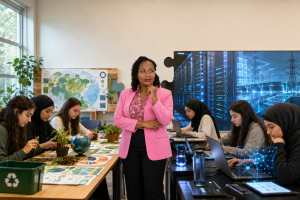
For example, rather than teaching statistical analysis or linear modelling through generic corporate datasets, my students engage with live metrics drawn from our own campus ecosystem. They track energy usage patterns, model carbon footprint fluctuations, and calculate the resource allocations necessary for local conservation initiatives. When students use system linear equations to optimize real-world renewable energy distributions or employ geometry to draft structural blueprints for sustainable infrastructure, mathematics no longer feels like an arbitrary hurdle. It was transformed into a superpower. We must consistently show our students that mathematics is not just about finding an isolated “X”; it is about identifying patterns, interpreting data, and driving tangible environmental change.
- In your experience, what are the most effective ways to encourage students to become problem solvers and innovators rather than simply learners of content?
Let us be totally honest here: if we want our children to stop acting like passive passengers who merely memorize content for a quiz, we have to completely change the environment in which they learn. For me, the absolute best way to build real innovators is through Problem-Based Learning (PBL). Because I am a math teacher, many people expect my classroom projects to be strictly about numbers and formulas. However, I love designing challenges where math is just the anchor, the starting point. To solve the problem, children must use more than just mathematics. They must step into the shoes of designers, negotiators, and environmentalists. They must consider resource management, human empathy, and how to clearly pitch their ideas to a team. It forces them to look at the whole, messy picture of a real-world problem rather than a clean equation on a worksheet.
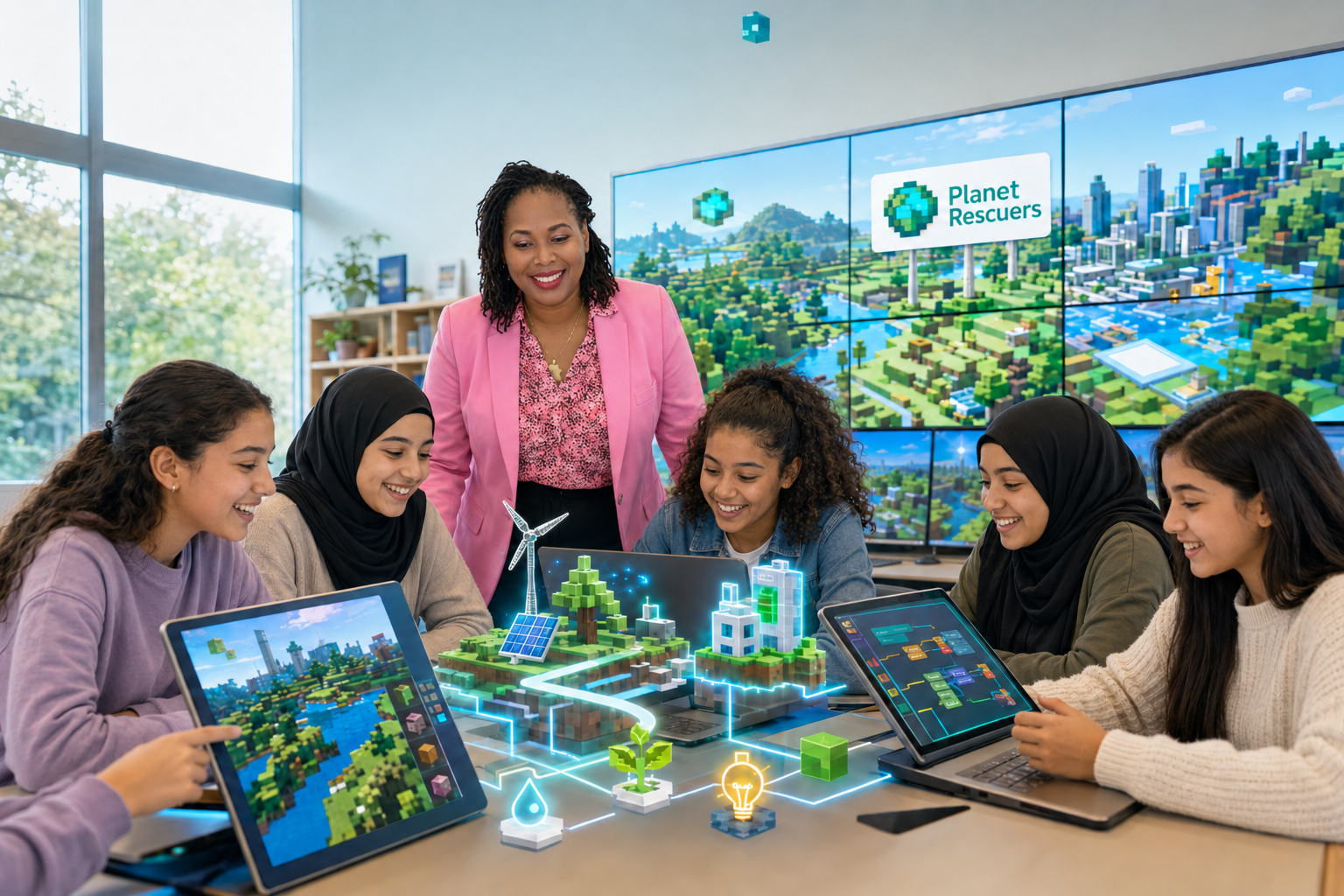
Hand-in-hand with that, I have fallen completely in love with Game-Based Learning. Children absorb a great deal of information when they are actively playing, exploring, and making decisions in a safe space. A perfect example of this occurred recently when my students played Minecraft: Planet Rescuers, an incredible educational game developed by Siemens Energy. They were absolutely obsessed. They were not just sitting in rows listening to me talk about the global clean energy transition. Instead, they were dropped right into a virtual world where they had to use logic, strategy, and environmental science to solve energy crises, and rescue communities.
Now, let me keep it completely real with you: time is a massive barrier to entry. The school schedule is always packed, the curriculum is tight, and setting up these complex, game-based, and problem-based projects takes a lot of late nights and extra planning on the teacher’s part. It is definitely not the easiest or fastest way to teach students. However, every time we do it, I am reminded of why it is worth the effort. It is much more effective than traditional learning. When a teenager plays a game to save a planet, they naturally absorb deep engineering and math concepts because they are determined to solve the puzzle. They are not just learning content anymore; they are practicing how to think like actual innovators.
- As technology continues to evolve rapidly, what skills do you believe today’s students need most to succeed in the future workforce?
 Think about this for a second: we are currently teaching students who are going to step into a workforce filled with jobs, software programs, and entire industries that have not even been invented yet. Because technology is moving at an absolute breakneck pace, teaching a student one specific technical skill, such as a single programming language or a specific software tool, is no longer sufficient. Sure, it might help them get an internship next summer, but by the time they are five years into their actual careers, that specific technology might be completely obsolete.
Instead of just stuffing their heads with temporary tech facts, we need to focus on what I call lifelong “meta-skills”, the kind of deeply human habits of mind that will help them survive and thrive no matter what changes around them:
- Learning on the Fly: Students need the confidence to realize when an old tool is no longer effective, lay it down without panic, and teach themselves how to use a brand-new system from scratch. Students need to be agile enough to know how and when to transfer their skills to a new task.
- Spotting the Noise: In a world where we are absolutely drowning in notifications, social media feeds, and AI-generated text, children need to be able to look at information, question where it came from, look for bias, and pull out what is actually true and ethical. Data literacy must be their first language.
- Radical Collaboration: The most massive and complicated problems in our world cannot be solved by one person sitting alone in a room. Our children must learn how to work with people from completely different backgrounds, cultures, and ways of thinking to solve problems together.
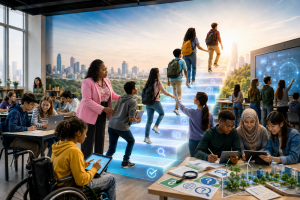
In my daily work with technology, I often discuss a concept called Techquity. It sounds like a big buzzword, but it is actually a simple and beautiful idea: it is about making sure that digital tools serve as a ladder to lift every single student up, rather than creating a bigger divide between the kids who have access and the kids who do not. If a student leaves our schools knowing how to ask smart questions, double-check facts with a critical eye, and learn on their own, they will not just be ready for the future—they will be the ones creating it.
- Sustainability has become an important focus across many disciplines. How can educators meaningfully integrate sustainability concepts into STEM learning experiences?
For sustainability integration to mean anything, it must be a top-down movement. Currently, there is insufficient genuine structural commitment to sustainability across the education sector. Instead, we have too many passionate teachers working entirely in isolation, exhausting themselves while hoping that a bottom-up model will somehow trick the system into changing. However, teachers cannot do this alone; they desperately need administrative and corporate backing. You cannot expect real change when a school’s day-to-day policies and organizational culture directly contradict what is being taught in the classroom. There is a specific term for this when organizations talk a big green game but do the exact opposite: green wash. Children are incredibly sharp; they see right through that dissonance, and it completely erodes their trust.
We must move past the phase in which sustainability belongs to just one person. A colleague of mine once joked to me in the hallway, “Lizzie, every single time I see your face, I suddenly remember to turn off my classroom projector and the AC at the end of the day!” We had a great laugh about it, but it really highlights the core issues. Sustainability should not be a running joke or a panicked reaction to seeing the resident “coordinator” walking down the hall. It should be completely ingrained in the marrow of an organization that it becomes second nature to everyone. When someone looks at a school, sustainability should be the first thing they see radiating through its formal policies, daily practices and overarching culture.
To make this a reality, schools need institutional sustainability policies that lay out crystal-clear expectations for both staff and students, backed by clear, measurable green KPIs. It must be a team sport. It cannot be about an individual champion; it must be about the whole unit, the entire school, and the complete organization. We all need to speak the exact same language and be clear about what that language means. Furthermore, this language should not stop at the school gates, it needs to spill over into our parents and our extended communities.
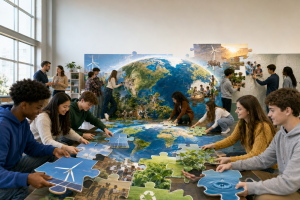
I always tell my students to think of this global crisis as a massive, intimidating jigsaw puzzle. No single person, classroom, or school can solve the entire puzzle independently. We cannot do everything, but we can completely master and solve our specific sections of the puzzle. When every group takes responsibility for their piece, they will fit together perfectly when joined.
A massive part of assembling that puzzle is championing the student voices. We must step out of the way and give them the microphone, letting them interpret and express their environmental views in a language they understand and relate to. As a Sustainability Coordinator and Mentor for the UN SDSN Global Schools Program, I am determined to provide this platform. A perfect example is our work with the Schools for Goal 7 initiative alongside the Global Schools Network and Siemens Energy, where our students presented at an event called “Students Powering the Clean Energy Future” at the ECOSOC 2026 Youth Forum side-event. They were not just reciting adult talking points; they were using their own language to shape the world they want to live in. When top-down administrative support is combined with loud, authentic student action, sustainability stops being a buzzword and becomes a lived reality.
- What role do emerging technologies, such as artificial intelligence, play in shaping the future of education, and how can schools prepare students to use these tools responsibly?
Trying to ban AI from a school is like trying to hold back a tidal wave with a plastic broom. It isn’t just impossible, it’s the wrong battle entirely. AI is not a passing trend. It is a permanent, structural shift in how human beings create, work, and solve problems, and the educators who are still debating whether to allow it are already a lap behind.
But here is where most school conversations about AI stop being useful. The debate stays stuck on academic integrity, are students ghostwriting essays?, when there are far more consequential questions on the table, and students are not being equipped to ask any of them.
Consider what we are deploying every time we open these tools in a classroom. A single query to a generative AI model consumes roughly ten times the electricity of a traditional search engine query. Perplexity AI alone processes over 600 million queries per month, each consuming approximately 290 watt-hours of electricity. Generating a five-second AI video uses around 3.4 million joules of energy, the equivalent of running a microwave for three and a half hours. Training the model that powers Microsoft Copilot, a tool now embedded in the Microsoft 365 suites many schools use daily, reportedly required approximately 700,000 litres of water for cooling alone. Google’s greenhouse gas emissions rose 48% between 2019 and 2023, driven primarily by AI data centre expansion. These are not projections. These are documented facts.
As a 2026 EDSAFE Women in AI Fellow, I see this as one of the most significant blind spots in education right now. We are teaching students about carbon footprints, conservation, and the SDGs in one lesson, and in the very next lesson assigning resource-intensive generative AI tasks with zero environmental literacy attached. That is not progressive pedagogy. That is institutional greenwashing, and our students deserve better.
What does responsible AI education look like in practice? In my classroom, students do not simply use AI, they audit it. When an AI generates a response, that output becomes the raw material for critical work: students identify factual errors, flag algorithmic bias, check data against primary sources, and rewrite the content in their own voice with their own reasoning. They also evaluate the tool itself, asking which platform they are using, what its Environmental Impact Rating is, whether the company has disclosed any sustainability commitments, and whether this task genuinely required a generative model or whether a simpler, lighter-weight tool would have met the same learning need.
This is AI literacy that is fit for purpose: students who understand prompt engineering and data privacy, yes, but also students who understand that every click activates a physical, resource-consuming global infrastructure, and that thoughtful citizens ask whether that cost is justified before they incur it.
The goal is not a generation of students who can type prompts fluently. It is a generation of leaders who can critically evaluate when AI should be used, when it should not, which tools carry the least cost for the most value, and how to hold the companies building these tools accountable for transparency.
(For a fuller, data-driven breakdown of the environmental and ethical dimensions discussed here including specific Environmental Impact Ratings for the tools commonly used in schools, I’d encourage readers to explore my feature article: The Hidden Cost of the Classroom AI Revolution: What Educators Need to Know)
- Looking back on your journey as an educator, what lessons have had the greatest impact on your teaching philosophy, and what advice would you offer to educators aspiring to make a lasting difference in their students’ lives?
My journey began in Bulawayo, Zimbabwe, where I taught across government, private, and mission schools before sharpening my Monitoring and Evaluation (M&E) skills as an intern for Family Impact. I have since lived and taught in Qatar and the UAE, which revealed one absolute truth: education is a messy, beautiful, relational business. It is vital to maintain consistent interactions through clear boundaries and rules, teaching responsibility by holding students accountable early. Ultimately, we must remember my favourite quote: “Each child’s life is alike a blank piece of paper upon which we all leave a mark.” Let us hold the pens with love, consistency, and a commitment to keeping curiosity alive.