

1. Overview of the School
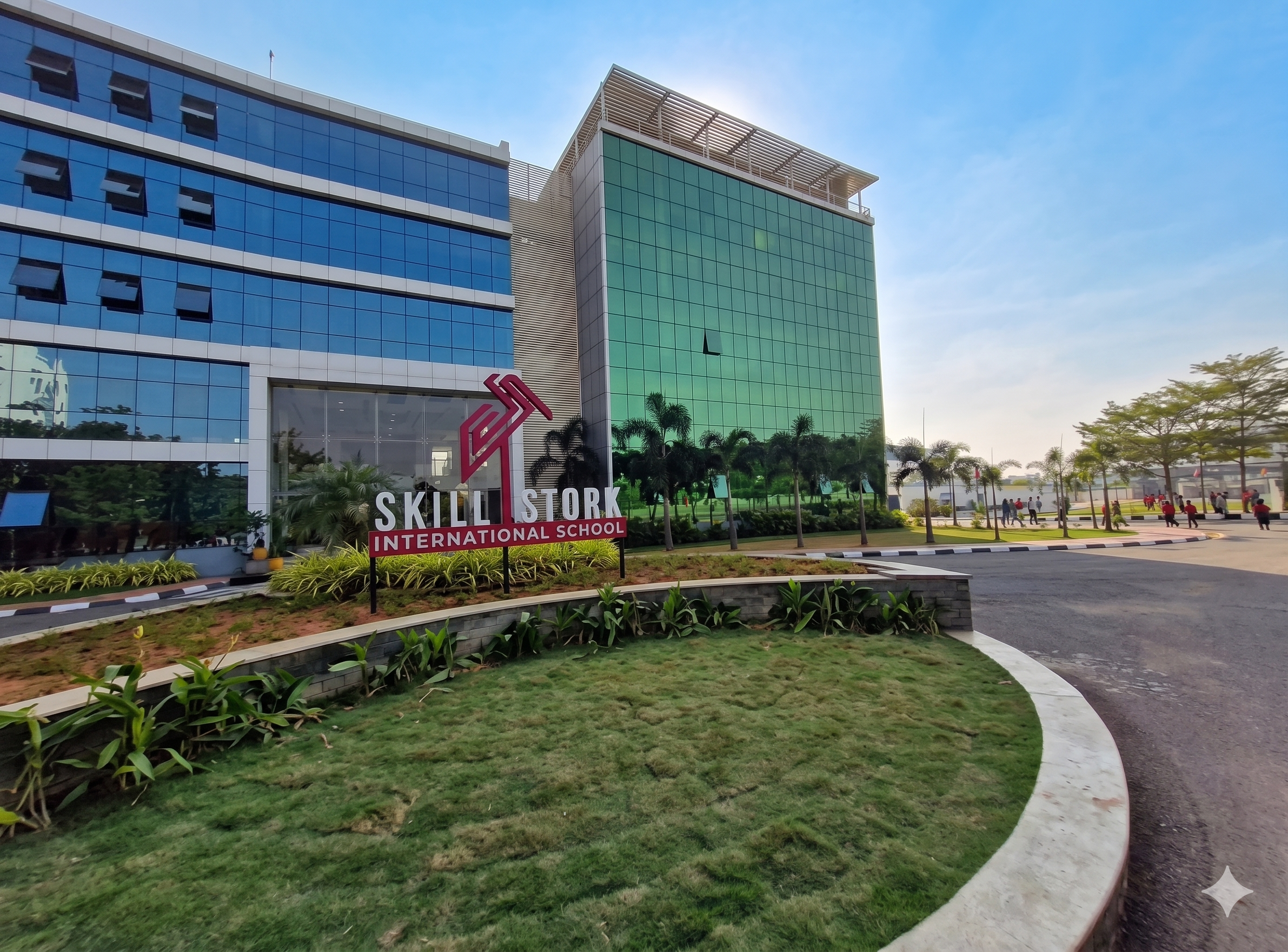
Located in Warangal, Skill Stork International School stands as a prominent K-12 institute offering international-oriented education through the three curricula of IB, Cambridge, and CBSE under a common academic framework.
Benefiting from the rich heritage of the SVS Group of Institutions, the school emphasizes high standards of academic performance, comprehensive personality development, and the education of learners in preparation for the future. By cultivating holistic individuals through progressive pedagogies, experience-based learning, and skill-oriented learning,
Skill Stork develops students with the ability to compete on a global platform.
The foundation of the learning curriculum at Skill Stork is a high degree of student-centred and enquiry-based learning, which enables them to build a concrete association with real-world concepts, particularly at the middle school level. Inculcated through a variety of stimulating teaching tools, interactive and student-friendly learning environments and
hands-on experiences, critical thinking, problem-solving and creativity are nurtured. Coupled with a modern campus, the facilitators, and a student-oriented environment, Skill Stork remains a trendsetter for imparting holistic education for the future.
2. Introduction to the STEM Programme
The Foundational Robotics and Drone Technology (STEM) programme at Skill Stork International School was conceptualized to give middle schoolers knowledge that can be applied in an era that is driven by technology. At a time when industries are being transformed through technologies like drones, robotics, and artificial intelligence, the school
decided to take the plunge to incorporate these high-tech subjects into its mainstream curriculum.
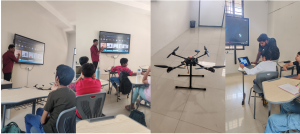
The chief project of the STEM program is its 10-Day Workshop on Drone Technology, Robotics & AI, which is an intensive hands-on learning experience, intended for middle schoolers of Grades 6-8. This program takes students through a complete journey from what a drone is and how it flies to building and piloting one. The workshop is rich in pedagogical methods, for the classroom work involves understanding the theories involved in robotics, AI, and drones, which is later followed by the practical aspect.
Some of the important themes addressed in the program are;
• Aerodynamics, safety regulations, and the drone industry
• Drone hardware such as motors, electronic speed controllers (ESCs), flight controller, battery, sensors, frames, etc.
• Flight controller software such as Pixhawk, Mission Planner and Q- Ground control.
• Autonomous flying, GPS-guided routes, waypoint missions, etc.
• Carrying capacity of drones and how it is useful in real-life fields such as agriculture, mapping, etc.
• Assembling a drone, soldering, balancing it and doing preflight safety checkups.
• Student teams construct their own drone, program it, fly it and compete in a flying contest.
This is a strong focus on learning through experience. Students are not only learning about the technology they are using, but they are also creating, debugging and operating it.
3. STEM Organisational Structure
The content of the programme alone will not make it successful – people and systems also have an equally vital role. There is a clear and collaborative structure in place to ensure that the STEM program runs smoothly at Skill Stork International School, and that it develops:
School Leadership
Senior leadership in the school acts as a sponsor for STEM integration in the school. Our Director, Principal, and the Coordinators have always held high expectations in the field of STEM. The institutional support, resources and vision to allow the program to continue and expand comes from senior school leadership.
STEM Facilitators
These are teachers in specific subject areas including Physics, Mathematics and Technology, who work together to deliver the program. Geet Kumar Thakur who is the Physics Facilitator at the school, lead the collaboration for drones and aerospace aspect. I ensure that core physics topics, such as forces, the laws of Newton and aerodynamics are clearly linked to the application of drone technology.
External STEM Partners
These are specialized STEM-based organizations, like Aerofoil Innovations Pvt. Ltd., which the school partners with to offer certain elements of the program which require expert delivery. These partnerships bring real-life experience into theclassroom; allowing for the development of the program to include up-to-date technology and expertise from professional engineers in the drone industry.
Students as Active Participants
In the middle school program students are not passive learners – they develop and take ownership of their learning through a program involving both team and individual design work involving drone projects, to design, build and fly their own drones.
4. Steps Taken to Implement the STEM Programme
Designing and implementing such a large and visionary program took a strategic approach. It was executed in phases with ongoing evaluation:
Phase 1 — Curriculum Design and Vision Setting
The school identified the core student competencies they aimed to nurture: technical knowledge, problem-solving, team collaboration and creativity. This helped shape a curriculum framework for Grades 6-8 that defined the competencies and the respective learning activities to ensure continuous development across the middle school level.
Phase 2 — Infrastructure and Resource Development
To support the advanced work on robotics and drones, specialized STEM spaces were set up with necessary tools. These included hardware like flight controllers (Pixhawk) as well as parts and frames for drones, computers that could handle the required simulation and mission-planning software, and an outdoor area for flight practice and displays.
Phase 3 — Partnership and Expert Engagement
Specialist expertise was identified as critical in navigating emerging technologies. Accordingly, STEM groups from the outside (Aerofoil Innovations Pvt. Ltd.) were engaged to help implement the program. Students thus had the chance to be mentored by real professionals who had experience working with these tools.
Phase 4 — Programme Rollout (10-Day Workshop Model)
The 10-day workshop was chosen as the principal delivery strategy. Its structure systematically moved students from foundational theory on Day 1, to live flight practice on Day 10. Quizzes, simulators, discussions and hands-on projects were included each day to enable progressive learning and monitoring progress. At the culmination of the workshop a
flying contest tested the skills acquired by the students.
Phase 5 — Reflection and Iteration
After the end of each course, learning outcomes were evaluated, student feedback was collected and problems were addressed so the program could be improved for future
iterations. Implementing a STEM programme of this scale and ambition required careful planning, phased execution, and ongoing refinement.
5. Challenges Faced and How They Were Overcome
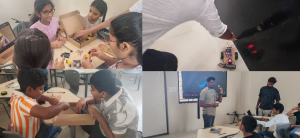
Challenge 1: Introducing Complex Technology to Young Learners
Drone technology, flight controller programming and autonomous navigation are abstract and advanced concepts for middle school students. This challenge was met by an extremely structured lesson – starting with an introduction which is as visual as possible (videos, group discussion, a ‘Drone or Not?’ game), and then carefully moving towards the
advanced concepts. Using simulation software prior to the live hardware gave students confidence and experience in a safe environment.
Challenge 2: Safety in Practical Activities
Working with real drones, motors and soldering kits comes with many inherent safety risks especially with younger participants. Safety training was embedded in the program from start to end-DGCA guidelines for safe flying of drones on day 1 to a complete pre-flight check on day 9. Each activity involving hands-on application had to be observed and
overseen by facilitators and failsafe were an integral part of the troubleshooting section of the curriculum.
Challenge 3: Sustaining Student Engagement Across 10 Days
A program this long had to carefully structured to keep participants hooked and maintain interest throughout. The lesson structure was rotated on a daily basis – theoretical classes alternated with simulations, hardware assembly and practical work, group challenges and competitive activities. A mention of the flying competition on day 10 of the program was an
excellent motivation strategy.
Challenge 4: Ensuring Inclusive Participation
Middle schoolers in 6-8th grade have highly different prior levels of exposure to technology. The program was created to accommodate this disparity through the mechanism of team work-the activities always encouraged the more able participants to mentor others and provide support in overcoming difficulties, and facilitators continued to provide
individual support to participants who needed extra assistance.
6. Impact of the STEM Programme
Students who undergo the 10-Day Drone, Robotics & AI workshop end up having a well-defined array of knowledge and experiences. By the end of the 10-day program, participants will have:
• Built and tested working drones from individual components and learned the engineering concept behind each component.
• Programmed flight controllers and planned autonomous GPS guided routes using industry level programs.
• Configured a payload system such as cameras and sensors and learned about real-world application of drone technology.
• Conducted a real flight test by flying their drones through an obstacle course or mission.
• Received a certificate of completion with an industry standard recognized.
In addition to technical knowledge the students show a tangible increase in their confidence levels, collaborative efforts,creative thinking and problem-solving skills.
A lot of students who earlier called themselves “not a science person” leaves the camp with a changed sense of belonging as a maker, engineer, and inventor.
Impact on School Culture
STEM is already a real part of the Skill Stork identity. It is in the school, fostering a culture of curiosity and making. It is in the air in the corridors-“Oh my god look, aerodynamics!”-where physics doesn’t feel so distant and theoretical because you can get your hands on it. Where learning is something that you do, not something that is done to you.
Impact on the School Community
This programme has received tremendous positive response from parents and also from the community. It has boosted parents’ confidence towards the school’s educational plans after observing their children build and fly their own drone and obtained the industry recognised certifications for the same. It has also triggered conversations regarding future
careers within the school regarding aerospace, engineering, AI and technology, for the coming years.
7. Major Achievements
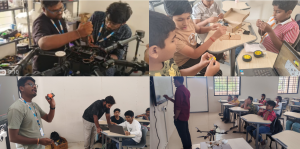
The Skill Stork International School STEM program has had the following key successes since its initiation:
• Delivery of a complete 10 Day Drone Technology, Robotics and AI Workshop which concluded in live student piloted flight tests by all cohorts participating.
• All students attending the workshop received an industry accredited certificate of participation demonstrating their proficiency with assembly, programming and operation of drones.
• Students’ acquisition of skills was advanced from novice to capable with all students being able to design and conduct mission flights using industry software (Mission Planner/Q Ground-Control) after 10 days of participation.
• Cross disciplinary STEM learning was demonstrated with links being established between Physics, Maths, Technology and Engineering in a integrated, project driven environment.
• The design of a repeatable and scalable model that can be replicated by multiple student cohorts and expanded into other areas of STEM.
• A reputation for innovation in middle school hands-on STEM curriculum in the school and among other institutions
Looking Ahead
Skill Stork International School’s STEM program is not a place, but a process that gets better and better with every cohort. Skill Stork intends to extend this program to the next level of robotics, and the application of AI and machine learning as well as creating an inter-school STEM competition. The aim is that every student that leaves Skill Stork is
ready not just to make his way in the world, but truly to take part in the construction of the world. When innovation learns to fly, students take to the skies.
About the Author:
 Geet Kumar Thakur is a passionate Physics Facilitator at Skill Stork International School with experience in IB, Cambridge, and STEM-based education. He specializes in integrating Physics with emerging technologies such as drones, robotics, and AI to create inquiry-driven, hands-on learning experiences for middle school learners. As the lead facilitator of the school’s Drone Technology, Robotics & AI programme, he focuses on fostering critical thinking, innovation, collaboration, and real-world problem-solving through experiential learning.